

By default, Binance will not let a system-generated API key place an order until the key is restricted to trusted IP addresses. OKX expires trade-enabled keys with no bound IP after 14 days of inactivity, and Bybit gives unbound keys three months. A trading bot therefore needs a fixed address, and a home line with a dynamic IP does not provide one.
A dedicated static proxy does, for $2 to $4 a month. In this ranking of the best proxies for traders, Proxys.io comes first for retail and small-desk use: it sells a single dedicated IPv4 with HTTP(S) and SOCKS5 on the same address, IP-based authorization and crypto payment, with no bundle minimum. IPRoyal, Decodo, Oxylabs and Bright Data follow, each with a narrower fit.
Table of Contents
- Why traders use proxies
- Which proxy type fits trading
- What a proxy does to latency
- How we ranked the providers
- The best proxies for traders: five providers compared
- Proxy errors on exchange APIs and what causes them
- How to test a proxy before you allowlist it
- When to change provider or drop the proxy
- FAQ about the best proxies for traders
- What to do first
None of them will make a slow route fast. The latency section explains why, with numbers.
Why traders use proxies
Four jobs account for most trading proxy purchases, and the best proxies for traders are chosen per job.
- A fixed egress IP for API key allowlists, when the bot runs on a home line, a laptop or a cloud platform that changes its address on every deploy.
- Keeping the home or office address out of exchange logs and third-party terminals.
- Fault isolation: order execution on one address and market-data collection on another, so that a ban earned by a scraper does not stop order flow.
- Collecting public market data such as price pages, news and listings from regional sources, usually through rotating residential IPs.
A proxy does not change which venues you may trade on. The IP should sit in the country where the account is registered and verified, and exchange terms and local regulation apply as before. Spreading requests across addresses to exceed published rate limits breaks the terms of most venues, and it does not work for orders anyway: Binance counts the order limit against the account, not the IP.
Which proxy type fits trading
The best proxies for traders who run API bots are, in most cases, dedicated datacenter IPv4 addresses. Such an address is static, costs the least, and lives in a data center, which is where exchange gateways live too. The weak point is filtering: in a CCXT study published in July 2026, Bybit answered HTTP 403 to New York probes on datacenter networks in four of five samples, while another US probe on a different network got a normal response.
A static ISP proxy (also sold as static residential) is the fallback for that case. The address is registered to a consumer internet provider but hosted on server hardware, and it costs $2.70 to $3.50 per IP among the providers below.
Rotating residential proxies bill per gigabyte and change the IP on a timer or per request. They cannot go on an allowlist, so their place is public data collection. Mobile proxies cost the most (a channel at Proxys.io starts at $56.79 for 30 days) and their speed depends on carrier load, which makes them hard to justify for order flow.
Shared proxies are the one type to avoid for anything that holds an API key. Binance accumulates request weight per IP address across every connection from that address, so a neighbor's polling eats your budget.
What a proxy does to latency
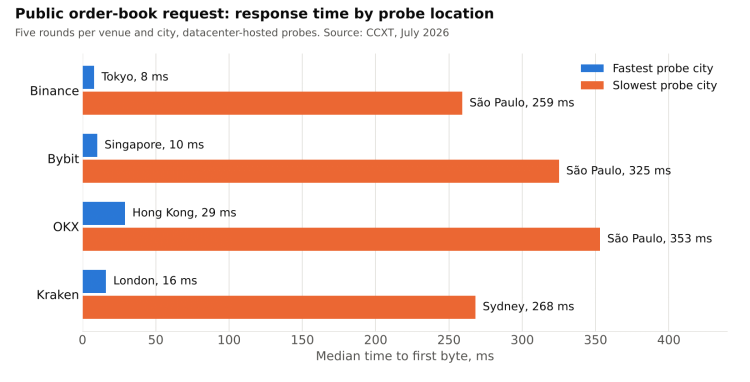
Distance to the exchange gateway outweighs everything else. The same CCXT study timed a public order-book request from eight cities: Binance answered in 8 ms from Tokyo and 259 ms from São Paulo, Bybit in 10 ms from Singapore and 325 ms from São Paulo, Kraken in 16 ms from London and 268 ms from Sydney. AWS describes the same geography in its own architecture notes: Binance in Tokyo, Bybit in Singapore, Coinbase in the US, Deribit in London.
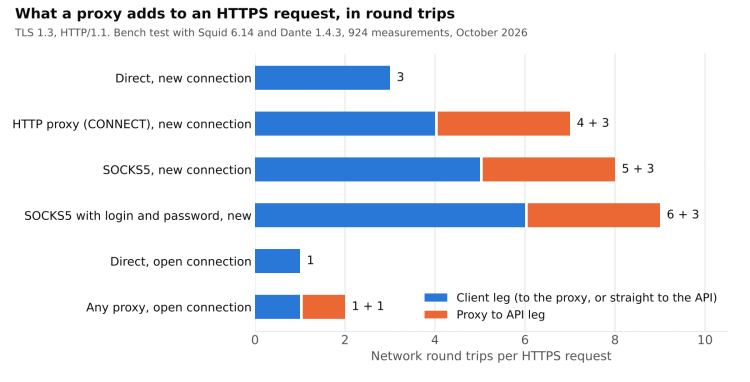
A proxy adds a hop to that path, and the cost depends on where the hop sits. We measured it on a bench in October 2026 with Squid 6.14, Dante 1.4.3 and six HTTP clients, 924 measurements in total. A new HTTPS connection takes three network round trips when made directly. Through an HTTP proxy it takes four round trips to the proxy plus three from the proxy to the API, and SOCKS5 with a login and password takes six plus three. On a connection that is already open, every route costs one round trip per leg.
Put numbers on it. With 15 ms from bot to proxy and 110 ms from proxy to exchange, against 120 ms direct (illustrative values, not measurements), a request on an open connection takes 125 ms instead of 120. Move the proxy off the route, 60 ms away from a bot that sits 20 ms from the exchange, and each request takes 75 ms instead of 20.
The proxy software itself added less than 0.1 ms per request in the same test. So the rules are short: keep connections open, use WebSocket streams where the venue offers them, and place the proxy next to the bot or next to the exchange. If a strategy needs single-digit milliseconds, rent a server in the exchange's cloud region and skip the proxy. The server's own static IP goes on the allowlist.
How we ranked the providers
To rank the best proxies for traders, we did not benchmark anyone against a matching engine. Prices and terms come from each provider's public pages, and the criteria are the ones an API trader hits first: whether one dedicated static IP can be bought on its own, what it costs, whether HTTP(S) and SOCKS5 both work, whether IP authorization is available, where the addresses are, and how you can pay.
The comparison was prepared by the Proxys.io team, so read the first entry with that in mind. The limits of each service, ours included, are stated in its card.
The best proxies for traders: five providers compared
The table lists entry terms for a dedicated static IP. The cards below it follow the ranking order.
|
Provider |
Dedicated static IP, entry price per month |
Smallest order |
Static IP locations |
Protocols |
Crypto payment |
|
Proxys.io |
$2.30 (datacenter IPv4); |
One IP |
IPv4: 70+ countries; ISP: 25 |
HTTP(S), SOCKS5 |
Yes |
|
IPRoyal |
$2.70 (ISP) |
Per proxy; 24-hour term also sold |
ISP: 31+ countries |
HTTP(S), SOCKS5 |
Yes |
|
Decodo |
$3.33 (ISP) |
Three IPs, $9.99 |
ISP: 19 countries |
HTTP(S), SOCKS5 |
On some plans |
|
Oxylabs |
$3.20 (ISP) |
Five IPs, $16 |
ISP: about 50 countries |
HTTP(S), SOCKS5 |
No |
|
Bright Data |
$3.50 (ISP) |
Ten IPs, $35 |
ISP: not itemized |
HTTP(S), SOCKS5 |
No |
Proxys.io
Proxys.io has sold proxies since 2016 and covers five types: datacenter IPv4, IPv6, ISP, residential and mobile. The product that matters for trading is the individual IPv4: $2.30 per address for one to four IPs, $1.60 from five, on a 30, 60 or 90-day term. Every address answers on HTTP(S) and SOCKS5, and access can be tied to your server's IP instead of a login, so no proxy password crosses the network in clear text.
It ranks first because nothing else in the table lets you start with one dedicated address at that monthly price, pay in USDT, Bitcoin or Ethereum, and move to an ISP address in Japan, Singapore, South Korea or Hong Kong inside the same account if a venue filters datacenter ranges. Support answers around the clock.
The limits are real. Static datacenter addresses run on a 7 Mbit/s channel (10 Mbit/s on request), enough for order flow and a watchlist of streams, not for an all-symbol depth feed. The ISP plan has no IP authorization, and its own page warns of possible limitations with Binance, so test before you allowlist. Refunds on IPv4 are accepted within 24 hours of payment. Run the test on day one.
IPRoyal
IPRoyal sells static ISP proxies at $2.70 per IP for 30 days, or $2.40 on a 90-day term, in 31+ countries with HTTP(S) and SOCKS5. Its distinguishing option is a 24-hour rental at $1.80, useful for checking whether a venue accepts the range before committing to a month. Crypto payment is accepted. The company's KYC policy means identity checks can stand between signup and full access.
Decodo
Decodo's dedicated ISP plan starts at three IPs for 9.99amonth(3.33 each) and drops to $2.90 per IP at ten. That bundle suits a small desk that wants a production address, a standby and a data-collection address from the start. Coverage is 19 countries, including Hong Kong, Japan and South Korea but not Singapore, where Bybit's infrastructure sits. The plan carries a 14-day money-back option.
Oxylabs
Oxylabs sells dedicated ISP proxies in self-service from five IPs for 16amonth(3.20 each), with HTTP(S) and SOCKS5 and ISP coverage of about 50 countries. Plans are subscriptions, and crypto is not among the payment options. It fits teams that already buy data products from the same vendor. One caveat for redundancy planning: since October 2026 Oxylabs and Decodo belong to the same holding, so using one as a standby for the other does not spread vendor risk.
Bright Data
Bright Data's dedicated ISP tier starts at ten IPs for 35amonth(3.50 each) with a 100 GB monthly fair-use allowance per IP. The verification process and account controls suit funds and data teams with a compliance department. For one bot and one API key it is more platform than the job needs.
Proxy errors on exchange APIs and what causes them
Most failures a trader blames on the proxy come down to six responses, and only the first is the proxy's own.
|
Response |
Sent by |
Root cause |
Fix |
|
HTTP 407 |
Proxy |
Wrong proxy login, or the client IP is missing from the proxy's own allowlist |
The request never reached the exchange. Correct the credentials and retry |
|
Error -2015: Invalid API-key, IP, or permissions for action |
Binance |
Egress IP is not on the key's trusted list, or a permission is missing |
Compare the request IP in the error text with the list in API Management |
|
Error 10010: Unmatched IP |
Bybit |
Request arrived from an address that is not bound to the key |
Bind the proxy IP to the key |
|
HTTP 429 |
Binance |
Request weight for the IP went above 6,000 per minute |
Wait for the Retry-After period and move polling to WebSocket streams |
|
HTTP 418 |
Binance |
Requests continued after 429; automatic IP ban lasting 2 minutes to 3 days |
Stop all traffic from the address until the ban ends, then add one shared rate limiter |
|
HTTP 403 |
Exchange firewall |
A firewall rule fired, or the network range is filtered |
Test a different IP type, for example ISP in place of datacenter |
Retry logic decides whether a 429 becomes a 418. On our bench, four workers that retried immediately turned 600 intended calls into 246,540 requests against a limit of 20 per second. One shared rate limiter in front of the same workers (nginx limit_req at 18 requests per second) produced zero 429 responses.
Orders need more care than reads. When a POST times out, the order may or may not exist. Binance's documentation says the same about 5xx responses and calls the execution status unknown. In the bench, blindly resending failed POSTs created 89 duplicates per 1,000 calls, and an idempotency key brought that to zero. On an exchange the equivalent is a client order ID (newClientOrderId on Binance, orderLinkId on Bybit): query by it before sending again.
A CONNECT or SOCKS5 proxy sees the destination host, the port and byte counts, while the API key and the order body stay inside TLS. Proxy logins travel in clear text in the first packet, which is the argument for IP authorization whenever the bot reaches the proxy across a network you do not control.
How to test a proxy before you allowlist it
Run this sequence inside the refund window.
- Buy one IP in the country of your verified account, in or near the exchange's region.
- Confirm the egress address in the proxy's dashboard or log, not from an HTTP 200. A NO_PROXY variable can route the request around the proxy without any warning, as it did once on our bench.
- Send 100 requests to a public endpoint, such as Binance's GET /api/v3/time, over one open connection, then repeat without the proxy. Compare the median and the 95th percentile.
- Add the address to the key's trusted list with read-only permission and call a signed account endpoint. A -2015 or 10010 at this step means the exchange sees a different IP.
- Enable trading, place a minimum-size limit order far from the market, cancel it, and read the X-MBX-USED-WEIGHT-1M header to see how much of the limit the test consumed.
When to change provider or drop the proxy
Change the address or the vendor when a static IP is replaced without notice, when the 95th percentile drifts to several times the median at quiet hours, or when a clean key starts returning 403. Try another IP type before another company: an ISP address is the first thing to test when a datacenter range is filtered.
For a single bot, a dedicated IPv4 from the Proxys.io private proxies range is the cheapest way to run that test, and a second address for data collection keeps the execution path isolated.
FAQ about the best proxies for traders
Does MetaTrader work through a proxy?
Yes. MetaTrader 4 and 5 have a proxy option in the server settings that accepts SOCKS4, SOCKS5 and HTTP. Latency to the broker's trade server still decides execution quality, so a VPS close to that server usually does more for a forex strategy than a proxy does.
Can a VPN replace proxies for trading?
For allowlists, rarely. Consumer VPN apps share exit addresses among many users and may change them between sessions, and exchange limits are counted per IP. A dedicated proxy gives one address that only your bot uses.
What to do first
Start with one address. Bind it to a read-only key, measure a day of latency at the 95th percentile, then enable trading. The best proxies for traders are the ones that keep the same IP for the whole rental term, and if a venue rejects the range with a 403, change the IP type before you change the provider.
 usdt
 bnb